
The avocado has become one of the most consequential commodities in North American trade. Bolstered by a record-breaking 300 million pounds of Mexican avocados imported for the 2026 Big Game and a further 239 million pounds imported for Cinco de Mayo, the United States is on track to import more than 2.5 billion pounds this year alone — a 120 percent increase over the past decade.
Behind that tonnage lies a binational economic engine generating $7.5 billion in U.S. economic output and more than $6 billion in Mexico, and one that sustains over 42,000 American jobs and 78,000 direct jobs in avocado orchards and packing houses in Michoacan and Jalisco.
All in all, since 2012, total economic output tied to Mexican avocado imports has grown by an incredible 340 percent. That tells an extraordinary story of growth, but as with all growth, sustainability is a factor. The durability of this binationally symbiotic powerhouse depends on something far more elemental than economic success: environmental leadership.
Mexico’s Unique Supply Chain Position — and Its Responsibility
Mexico is the only country currently capable of meeting year-round U.S. demand at scale. Its mature supply chain infrastructure, integrated grower-packer-importer ecosystem, and deep market penetration (Mexican avocados reach 70% of U.S. households) make it an irreplaceable partner. In an era of supply chain fragility and heightened trade tensions, that kind of reliability is a strategic asset.
But sustaining that unique position requires protecting the bountiful natural resources of Michoacan and Jalisco that make year-round avocado production possible: natural irrigation, nutrient-rich soil, biodiversity, and long-term farm viability. In other words, the economic and environmental dimensions of this industry are one and the same conversation.
Growth and Its Pressures
Rapid expansion brings real challenges. Rising U.S. demand has increased internal pressures to continue good stewardship of the resources that make the industry possible, and positioned supply chain transparency as an external prerequisite for market access.
And for an industry with more than $13 billion in combined binational economic output, those kinds of pressures represent an opportunity for cultivating trade relationships, regulatory standing, and long-term competitiveness.
The Strategy: The Path to Sustainability
The Mexican avocado industry, represented by APEAM and MHAIA, is looking ahead. Its leaders understand that sustainability isn’t a constraint on growth or a conciliation — it’s the prerequisite undergirding the entire operation. Protecting forests protects exports. Protecting watersheds protects growers. Protecting biodiversity protects long-term yields. And transparency protects the trade relationships that keep supply chains open.
All these elements are formalized in the Mexican avocado industry’s Path to Sustainability, a comprehensive strategy now approaching its one-year milestone that represents a structural move from reactive compliance to proactive environmental stewardship. The strategy establishes a governance architecture, data-driven land-use analysis, biodiversity baseline studies, and coordinated efforts to conserve and revitalize the natural environments where avocados are grown. Together, the Path to Sustainability embeds sustainability directly into the economic model — not layering it on as an afterthought.
Of the 35,000 independent avocado growers in Michoacan, 80 percent operate farms averaging just eight acres. Nearly all the orchards have been run by small families for generations, tying their livelihoods to the health of the land they tend. The Path to Sustainability encourages an already-existing culture of stewardship among the growers, who are naturally aligned with the Path to Sustainability.
The strategy protects U.S. interests, too: sustainable production secures tens of thousands of U.S. jobs, retailers, restaurateurs, and consumers. And with the approaching United States–Mexico–Canada Agreement (USMCA) review in July, environmental and social labor standards rising, and corporate disclosure standards tightening across global supply chains, the Mexican avocado industry is navigating a policy environment that increasingly demands environmental accountability as a condition of trade.
Building Growth That Lasts
The global policy environment increasingly demands environmental accountability alongside economic performance. Amid its historic escalation in production and economic output, the Mexican avocado industry is signaling a commitment to stewardship, both to its land and its international trade partners. The two are conjoined: Economic growth without environmental strategy is short-term thinking. It’s by environmental leadership that the industry will earn the right to keep growing.

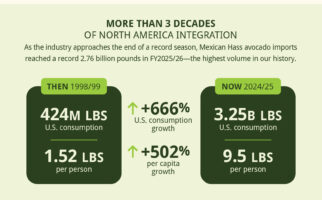
For nearly 30 years, the Mexican Hass avocado trade has demonstrated how North American integration creates value for workers, businesses…

The United States imported more than 300 million pounds of Mexican avocados in the four weeks leading up to the…
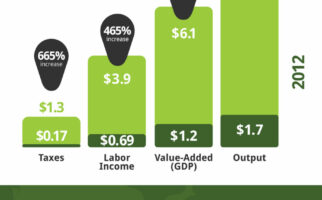
As avocado consumption in the U.S. continues to rise, imports of Mexican Hass avocados make significant contributions to both the…




© 2020 Avocado Institute of Mexico. All Rights Reserved.